

How much does it cost to soundproof a gaming room in an HDB flat?
Soundproofing a gaming room in an HDB flat needs a room-specific quotation in SGD; there is no defensible fixed total without defining the noise source, affected surfaces and installation scope. Include finishing, ventilation changes and any reinstatement work in that quotation—not just acoustic materials.
TL;DR
- Soundproof gaming room cost Singapore: compare installed scope, not foam coverage or an unsupported average.
- Acoustic panels reduce room reflections; they do not replace sound-isolating construction.
- Armaggeddon PC gaming equipment belongs in a separate budget from building work.
- Identify whether voices, speakers, bass or desk vibration cause the disturbance before requesting quotations.
Why this matters
A quieter microphone recording and a quieter neighbouring room are different targets. Foam or fabric panels address reflections inside your room. Sound isolation addresses noise travelling out through doors, walls, windows and connected structures.
Start with the noise path. The practical guide to soundproofing a gaming room in an HDB flat covers the setup side; this page explains how to specify and compare the work you are paying for.
For a 2026 renovation, ask contractors to separate acoustic treatment from sound isolation. Otherwise, a quotation filled with attractive wall panels can leave the actual disturbance unresolved.
How much does it cost to soundproof a gaming room in an HDB flat?
The cost depends on the installed solution, not the gaming label. Get an itemised SGD quotation against a defined noise problem before setting a construction budget. A room used with headphones and normal conversation needs a different assessment from one used with loud speakers and a subwoofer.
Use this breakdown when comparing proposals. Each line should state what is included, what is excluded and how the contractor will check the result.
| Work package | What the quotation should specify | Why it affects your decision |
|---|---|---|
| Assessment | Noise source, receiving room and suspected transmission paths | Establishes whether the proposed work targets the complaint |
| Door assembly | Door leaf, frame, perimeter seals, threshold and installation | A door upgrade is incomplete if gaps remain untreated |
| Window work | Existing condition, proposed assembly and perimeter treatment | Window work must match the identified external noise path |
| Wall or ceiling work | Full assembly, junctions, penetrations and finished dimensions | Surface panels and isolating construction are different products |
| Ventilation | How airflow remains safe and usable after the work | Closing gaps changes how the room exchanges air |
| Making good | Painting, electrical adjustments, disposal and reinstatement | These tasks belong in the installed scope |
| Verification | Listening locations, operating conditions and agreed checks | Makes the intended outcome clear before payment |
Do not compare a materials-only proposal with a completed installation. Ask whether GST, site protection and disposal are included, and request that exclusions appear beside the relevant work package.
A useful quotation also names the receiving space: the next bedroom, corridor or another flat. “Make the gaming room quieter” is not a measurable brief.
Which approach should you budget for?
Choose the approach by the problem it solves. These are different scopes, not interchangeable tiers with predictable results.
| Approach | Best for | Main benefit | Main limitation |
|---|---|---|---|
| Source control | Headphone gaming and avoidable speaker noise | Reduces noise before it reaches the room boundaries | Does not contain your voice |
| Acoustic treatment | Echo and reflective microphone recordings | Controls reflections inside the room | Does not substitute for sound isolation |
| Targeted isolation | An identified door, window or junction problem | Directs work at a confirmed transmission path | Other paths can remain audible |
| Coordinated isolation | Multiple transmission paths needing construction work | Addresses connected weaknesses as one design | Requires more disruption and careful detailing |
Source control: start before construction
Best for: players whose main disturbance comes from speakers or a subwoofer. Switch to headphones, lower unnecessary playback volume and remove avoidable desk rattles before requesting building work.
Source control is reversible. It also helps you separate game audio from speech, keyboard impacts and equipment noise.
The limitation is simple: headphones do not stop shouting. If conversation is the disturbance, repeat the assessment with game audio muted and your normal voice-chat behaviour unchanged.
Acoustic treatment: choose it for reflections
Best for: echo, harsh room reflections and microphone recordings. Absorptive treatment changes how sound behaves inside the room. It is useful when your recording sounds hollow or reflective.
Do not buy treatment as proof that neighbours will hear less. Ask the supplier whether the proposal describes absorption performance or transmission loss; those measurements answer different questions.
For a 2026 quotation, specify the intended result in ordinary language. “Reduce audible echo during voice calls” is clearer than “install gaming-room acoustics.”
Targeted isolation: confirm the weak point first
Best for: a clearly identified leakage path. A contractor might propose work around a door or window after checking where sound escapes.
The advantage is focus. The drawback is that sound also travels through other paths, including junctions and connected structures.
Do not accept a promise based only on the appearance of the existing door. Ask how the installer assessed the whole opening, including the frame and threshold.
Coordinated isolation: assess the whole room
Best for: persistent disturbance involving several transmission paths. This approach treats the room as connected construction rather than a collection of decorative surfaces.
It requires attention to boundaries, openings, services and ventilation. Added linings also reduce usable space, so request finished internal dimensions before approving the layout.
The limitation is disruption. Agree on access, protection, electrical work and reinstatement before the installation begins.
Why soundproofing scope varies
These factors explain why seemingly similar rooms receive different proposals. Ask contractors to connect each recommended item to your actual noise problem.
- Noise source: speech, loudspeaker audio, bass and physical impacts require different responses. A quotation should identify which source it addresses.
- Transmission path: sound through a door gap is not the same problem as vibration entering a floor or wall. Treating the wrong path wastes work.
- Existing construction: doors, windows, junctions and service penetrations affect the proposed assembly. Site conditions matter more than a generic room package.
- Treatment area: a selected opening and a coordinated room installation involve different amounts of labour, materials and finishing.
- Ventilation and services: acoustic changes must account for airflow, electrical access and maintenance. Do not cover necessary openings or equipment vents.
- Acceptance standard: a subjective listening check and a specified acoustic assessment are different deliverables. Agree on the method before work starts.
These are scope drivers, not a formula for estimating a total from floor area alone. A larger surface area does not identify which boundary needs treatment.
How do you get a useful soundproofing quotation?
Prepare the same brief for every contractor. In 2026, comparable scope is more useful than collecting headline totals that describe different jobs.
- Name the disturbance. Write down whether the issue is voices, speaker audio, bass, keyboard impacts or PC noise. Keep separate problems separate.
- Name the listener. Identify where the disturbance is heard. Include whether the affected person is inside your household or outside the flat.
- Describe normal use. State whether you play with headphones or speakers, use voice chat and keep the room door open or closed.
- Document the room. Provide dimensions, photographs and the positions of doors, windows, sockets, air-conditioning and furniture.
- Request matching scope. Ask each contractor to separate assessment, installation, finishing, ventilation and verification.
- Agree on acceptance. Record the operating conditions and listening locations used to judge the result.
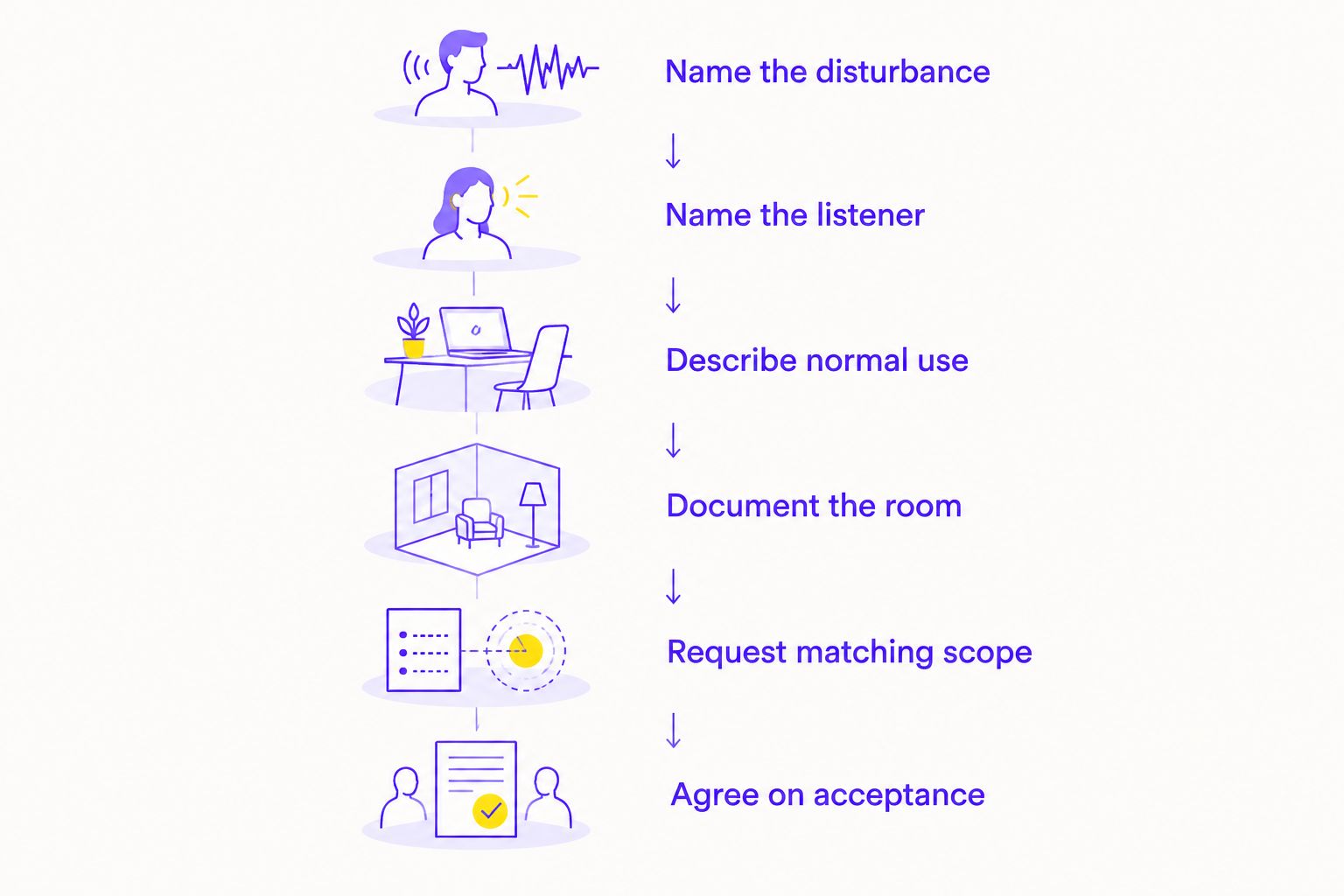
Keep a copy of the agreed brief with the quotation. Changes to speaker position, playback level or ventilation after installation make before-and-after comparisons less useful.
What should the acceptance check include?
Use the same audio source, source position and operating settings before and after the work. Record the door and window positions, and keep the receiving location consistent.
If a contractor promises a reduction in decibels, ask what is being measured and under which conditions. A laboratory rating for a component is not a guaranteed result for your installed room.
Phone recordings help document a complaint, but they do not replace a specified acoustic measurement. Automatic microphone processing changes recordings, so avoid treating a phone clip as certified evidence.
What should HDB owners check before approving work?
Confirm the proposed renovation against current HDB requirements before installation. Ask the contractor to identify applicable permissions and explain whether the design affects walls, windows, doors, electrical services or ventilation.
Do not assume an acoustic upgrade permits structural alterations. Do not obstruct required access or change a fire-rated assembly without checking the applicable requirements.
For a 2026 project, obtain the current requirements from HDB rather than relying on an old renovation quotation. Get written clarification when the proposed scope is unclear.
If you rent the flat, obtain the owner's permission before adhesive treatments or permanent work. Include removal and reinstatement responsibilities in the agreement.
Where do monitors and gaming equipment fit in the budget?
Keep the display budget separate from the acoustic budget. A monitor upgrade changes the viewing experience; it does not improve the room's sound isolation.
Plan desk depth, screen position and cable access before approving new wall linings. Check the finished layout with the chair pulled back, not just with furniture pushed against the wall.
If you use monitor speakers, include them in the noise assessment. Muting those speakers while using headphones removes that playback source, but it does not address speech or physical vibration.
Armaggeddon PC is best for gaming-equipment shopping, not specifying HDB sound-isolation construction. Keep those purchasing decisions separate.
One relevant equipment option is the Armaggeddon Cosmic III Lite gaming headset. Its supplied product description lists a 165g weight, while the product title specifies 40mm drivers and 2.4GHz connectivity. Its role here is headphone playback instead of room speakers—not a claimed reduction in sound travelling through your walls.
Do not interpret headset connectivity or driver size as acoustic-isolation performance. Neither specification establishes how much your household or neighbours will hear.
Can acoustic foam replace soundproofing work?
Acoustic foam is not a replacement for sound-isolating construction. It addresses reflections inside the room, while isolation depends on the complete boundary and its openings.
Choose foam or other absorbers when your problem is echo. Do not approve a wall-coverage package as the answer to bass transmission without an assessment.
Will headphones remove the need for renovation?
Headphones remove the need to play game audio through room speakers, but they do not contain your voice. Test that change before commissioning construction.
If the complaint remains with speakers muted, investigate speech, impacts and equipment noise separately. That distinction gives the contractor a more useful starting point.
Is a room-area quotation enough?
Room area alone is not enough to define soundproofing work. It does not identify openings, weak junctions or the receiving location.
Ask for the assembly and installation details behind the quotation. Reject comparisons that treat decorative treatment and sound isolation as equivalent scope.
FAQ
How much should I budget to soundproof an HDB gaming room in Singapore?
Set the budget from an itemised SGD quotation for your room and noise problem. Include installation, finishing, ventilation provisions and verification rather than comparing materials alone.
What's the best first step before paying for soundproofing?
Identify the noise source and where it is heard. Test with speakers muted so you can separate playback noise from speech and physical impacts.
Is acoustic treatment better than soundproofing for gaming?
Acoustic treatment is better suited to controlling room reflections, while sound isolation addresses transmission between spaces. Choose according to the problem rather than treating them as competing versions of the same product.
Can I soundproof my HDB room with curtains and rugs?
Curtains and rugs are not substitutes for a designed sound-isolating boundary. They can change room reflections or soften some contact sounds, but they do not establish an isolation result.
Do I need to check HDB requirements before installing acoustic work?
Check current HDB requirements before approving renovation work. Ask the contractor to identify any applicable permissions and restrictions for the exact proposal.
Will a gaming headset stop neighbours hearing voice chat?
A gaming headset does not contain your speaking voice. It replaces speaker playback, so assess voice levels separately.
Should I replace my monitor to make the gaming room quieter?
Replacing a monitor does not soundproof the room. If monitor speakers are contributing to the disturbance, mute them and assess the remaining noise before buying equipment.
One last thing
Check the receiving space, not just the gaming chair. A room that sounds less echoey to you has not necessarily become quieter for the person next door.
For your 2026 project, write the listener's location into the brief before you request quotations. That detail keeps the proposed work focused on the disturbance you need to solve.